GEO optimization (Generative Engine Optimization) means setting up your website and copy so that AI assistants — ChatGPT, Perplexity, Gemini and Google’s AI Overviews — find your site, understand it and cite it as a source in their answers. There’s no separate magic here: the foundation is the same as in SEO — the site has to be indexed and load fast. On top of that come three things: access for AI crawlers, copy with direct answers and numbers, and mentions of your brand on other websites.
Below we explain in plain words what GEO optimization is and how it differs from regular SEO, what you can do yourself, and how to check whether AI can see your website. Everything links to Google’s and OpenAI’s documentation and to the research paper that coined the term.
What GEO optimization is, in plain words
When someone asks Google or ChatGPT, say, “where can I order a website for a clinic”, they more and more often get not a list of ten links but a ready answer with a few sources listed under it. GEO optimization is about making sure your site is among those sources. In regular SEO the goal is to rank high in the list of results; in GEO it’s to get into the answer itself.
The term first appeared in 2023 in the paper “GEO: Generative Engine Optimization” by researchers from Princeton University and the Indian Institute of Technology Delhi; in 2024 it was presented at the KDD conference. The authors tested which changes to a text help a page show up more often in the answers of generative engines. We’ll come back to their findings in the section on copy.
You’ll come across other names too. AEO (Answer Engine Optimization) means optimizing for “answer engines”: the term is older and used to refer to voice assistants and Google’s featured snippets. LLMO means optimizing for large language models. Nobody has officially drawn lines between them, so in practice they’re near-synonyms. We say “GEO” because that’s what people search for most.
| Regular SEO | GEO | |
|---|---|---|
| Where the result shows | a list of links in search | the text of an AI answer with links to sources |
| What counts as success | a high position and a click to the site | your site is cited or your company is named in the answer |
| What matters most | indexing, speed, keywords, links | the same, plus access for AI crawlers, direct answers, sourced numbers, brand mentions |
| How to measure it | Search Console, analytics | manual answer checks, referrals from chatgpt.com and perplexity.ai, Search Console |
The key takeaway from this table: GEO optimization doesn’t replace SEO, it builds on top of it. Google says so directly: to appear in AI Overviews and AI Mode there are no additional requirements and no special optimizations needed — the same fundamentals as for regular search apply (Google Search Central). So if your site is poorly indexed or slow, start there, not with “secret tricks for ChatGPT”.
Why GEO matters for business in 2026
AI has already become a normal way to look things up. In February 2026 OpenAI announced that 900 million people use ChatGPT every week (TechCrunch). And Google’s AI Overviews have been available in more than 200 countries and over 40 languages since May 2025, including Ukraine and the Ukrainian language (mezha.ua). So your customer sees an AI answer even when they simply google something.
This is already changing how people behave. Pew Research Center analyzed the searches of 900 US adults in March 2025: when an AI summary appeared in Google, people clicked a regular link in 8% of visits, versus 15% without one (Pew Research Center). Links inside the summary itself were clicked in only 1% of visits.
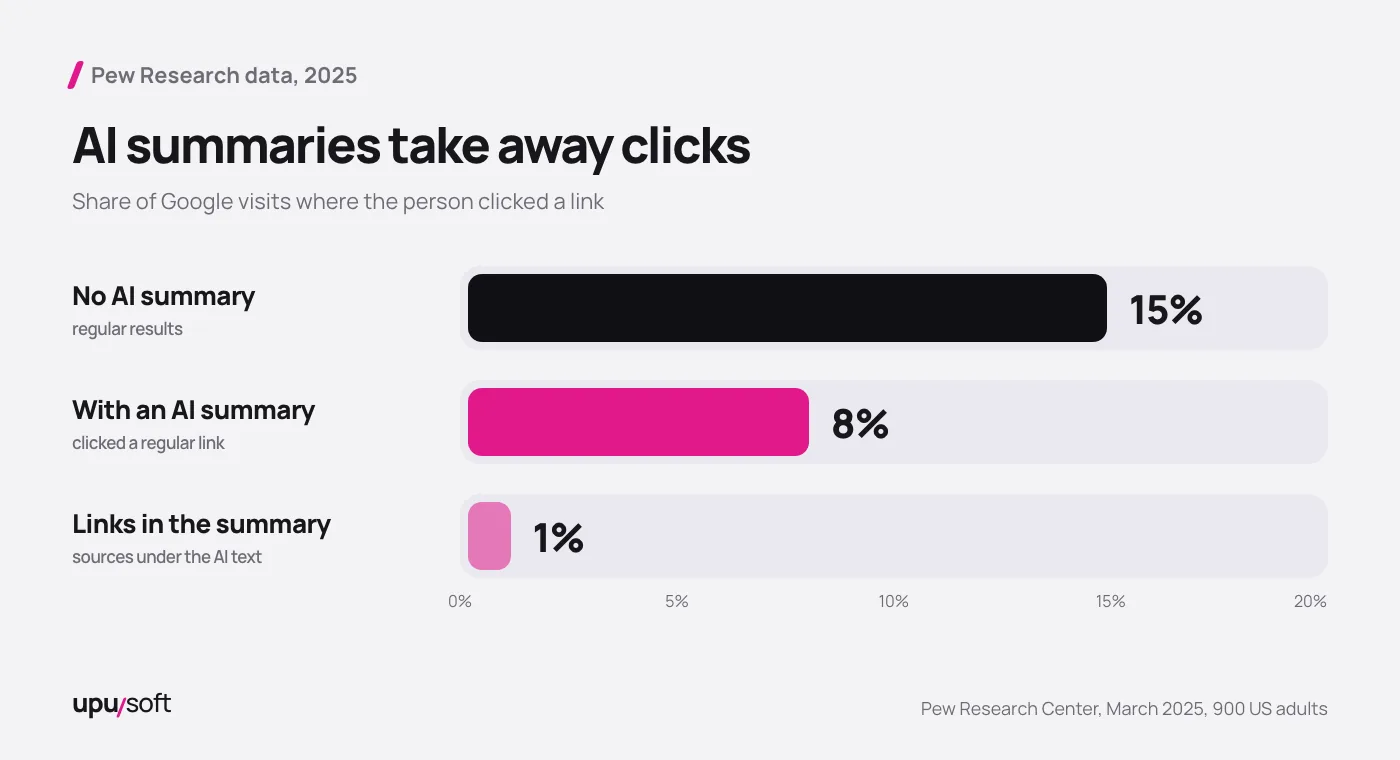
For a business the conclusion is simple: there are fewer clicks from search, so the value moves into the answer itself. If AI names your company among three options, people remember the name even without clicking and find you directly later. If it doesn’t, you practically don’t exist for that person, no matter where your site ranks in regular results.
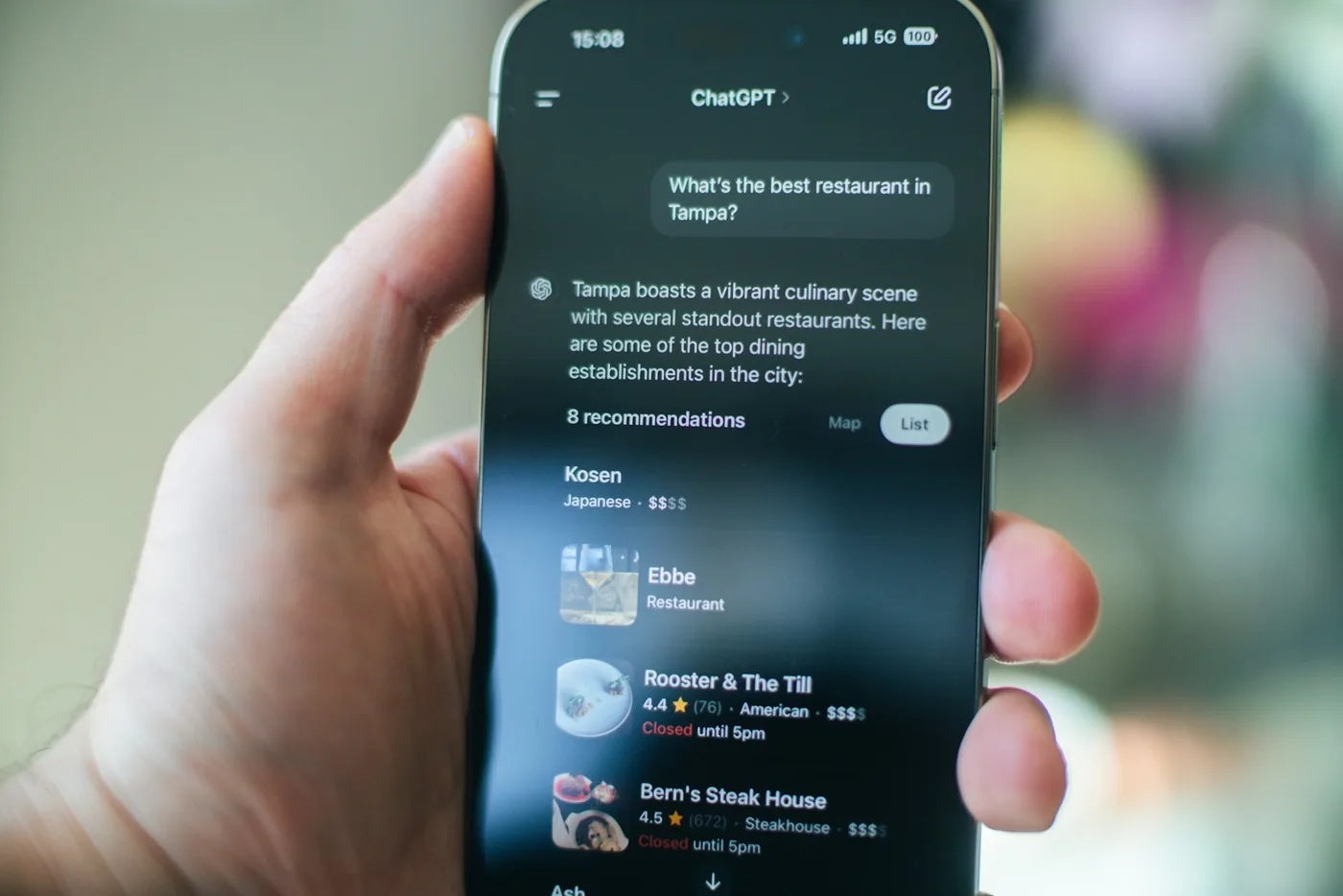
An honest caveat: for most websites, regular Google still brings most of the search traffic — that’s easy to check in your own analytics. So GEO optimization is more of an investment a year or two ahead than a “more leads tomorrow” button. But the basic steps — opening your site to AI crawlers and writing copy with direct answers — are cheap and improve regular SEO at the same time. That’s why we do them on every site as part of basic SEO.
How AI chooses whom to cite
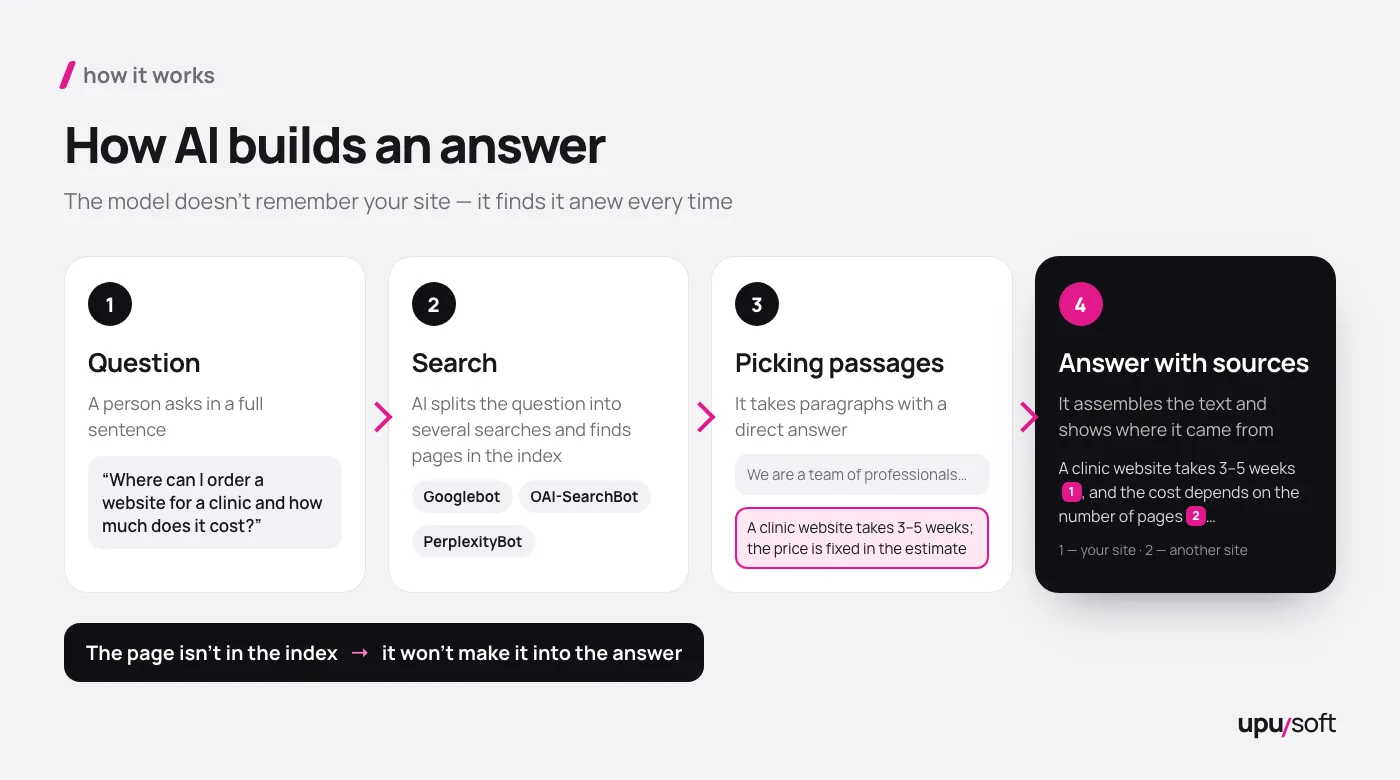
When a question is about fresh facts, prices or specific companies, an AI assistant usually doesn’t answer “from memory” — it searches the web. First it finds pages, then picks the passages that best answer the question, and builds an answer from them with links. The model doesn’t remember your site — it finds it anew every time. So a page that isn’t in a search index won’t make it into the answer, however useful it is. This is exactly where GEO optimization comes in: helping AI find the page and pick the right passage from it.
For AI Overviews and AI Mode, Google uses a technique called query fan-out: it splits one question into several searches across subtopics and builds the answer from different pages (Google Search Central). A useful consequence: not only top-ranking pages have a chance, but also those that best answer a narrower part of the question — for example, “how much does it cost” or “how long does it take”.
Where different services get their pages:
- Google’s AI Overviews and AI Mode — from Google’s index, with pages crawled by the regular Googlebot;
- ChatGPT — has its own search crawler, OAI-SearchBot, and also uses third-party search providers; OpenAI’s help center names Bing among them (OpenAI Help Center);
- Perplexity — its own search crawler, PerplexityBot;
- Claude — the search crawler Claude-SearchBot;
- Gemini — Google Search.
None of these companies discloses its full rules for picking sources. But the common logic is clear: a page has to be accessible to the crawler, indexed, and contain a clear answer to a specific question. The first two conditions are purely technical, and that’s where GEO optimization starts.
The technical side of GEO optimization: making sure AI can see your site at all
robots.txt: which bots to allow
Technical GEO optimization starts with robots.txt. It’s a file in the root of your site that says which bots may access your pages. A detail that’s often missed: every AI company has several bots with different jobs. One collects text to train models, another indexes pages for search, a third opens a page when a specific user asks about it. If you block them all with one rule, your site disappears from ChatGPT or Perplexity search, even though you may only have wanted to opt out of training.
| Bot | Company | Used for | If you block it |
|---|---|---|---|
| Googlebot | regular search, AI Overviews, AI Mode | the site disappears from Google entirely | |
| Google-Extended | Gemini training and answers outside Search | doesn’t affect inclusion in Google Search | |
| OAI-SearchBot | OpenAI | ChatGPT search | the site won’t appear in ChatGPT search answers |
| GPTBot | OpenAI | model training | doesn’t affect ChatGPT search |
| ChatGPT-User | OpenAI | opens a page when a user asks | ChatGPT can’t read the page when asked to |
| PerplexityBot | Perplexity | Perplexity search | the site disappears from Perplexity results |
| Claude-SearchBot | Anthropic | Claude search | lower chance of appearing in Claude’s answers |
| ClaudeBot | Anthropic | model training | doesn’t affect Claude search |
Sources: documentation from Google, OpenAI, Perplexity, Anthropic.
Our advice: always allow the search crawlers — Googlebot, OAI-SearchBot, PerplexityBot, Claude-SearchBot. Training bots are your call. Blocking them doesn’t remove you from search, but models will know less about your brand when they answer without searching. For a small business that wants to be known, we recommend allowing them too. The simplest robots.txt that lets everyone in looks like this:
User-agent: *
Allow: /

Sitemap: https://example.com/sitemap.xml
And if you only want to opt out of OpenAI model training without touching ChatGPT search, add a separate rule just for GPTBot:
User-agent: GPTBot
Disallow: /
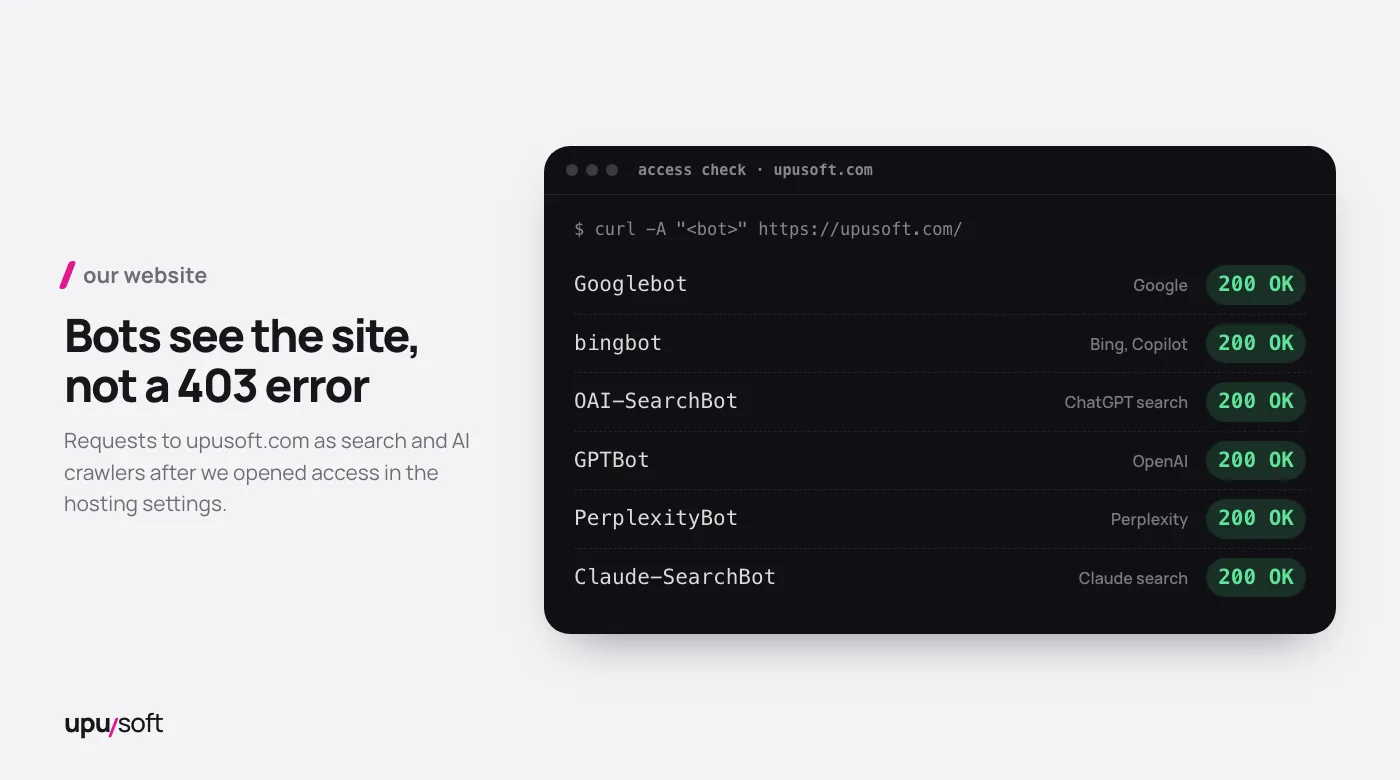
Check not only the file itself but what the bot actually gets: this is a typical reason GEO optimization doesn’t work. On our own site robots.txt was set up correctly, but the hosting control panel was appending its own blocks to the file, and the server answered some AI crawlers with a 403 “forbidden” error. We fixed it in the hosting settings. The simplest check is to open yoursite/robots.txt in a browser and see what’s really there. A developer can send a request as any bot in a minute and make sure the server returns the page with a 200 status.
Indexing in Google and Bing
Without indexing, no GEO optimization will work. AI Overviews take pages only from Google’s index: to become a source, a page must be indexed and eligible to be shown in Search. You can check this in Google Search Console, in the “Pages” report. Google counts traffic from AI Overviews and AI Mode in the overall “Performance” report — there are no separate stats for it.
Bing is often forgotten, and that’s a mistake: Copilot runs on its results, and OpenAI names it among ChatGPT’s search partners. Connect your site to Bing Webmaster Tools — you can import it from Search Console in a few minutes — and submit your sitemap there.
Text in the HTML, not only in JavaScript
Googlebot can run JavaScript, but AI crawlers mostly can’t. An analysis by Vercel and MERJ showed that none of the major AI crawlers (bots from OpenAI, Anthropic, Meta, ByteDance) execute JavaScript: they see only the HTML the server returns (Vercel). For GEO optimization this is critical: if your copy, prices or reviews are loaded by a script after the page opens, they don’t exist for AI.
It’s easy to check: open the page, press Ctrl+U (“View page source”) and search for a phrase from the text. If it’s there, the bot sees it. WordPress sites usually serve text right away, but React or Vue apps without server-side rendering and some website builders are worth checking.
Schema.org markup
Schema.org markup is a machine-readable description of a page: “this is a company with this name, address and phone number”, “this is an article with an author and a date”, “this is a block of questions and answers”. Google says plainly that no special markup is needed for AI Overviews, and that the markup you do have must match the visible text (Google Search Central).
So in GEO optimization, markup isn’t a ticket into AI answers but a way to state unambiguously who you are and what a page is about. The minimum set for a business site: Organization or LocalBusiness on the home page, Article for blog posts, FAQPage for a Q&A block. You can check your markup with Google’s Rich Results Test.
llms.txt: needed or not
llms.txt gets the most attention in GEO optimization discussions, though it matters the least. It’s a text file in the root of a site with a short description of the company and a list of its main pages, to make the site easier for a language model to understand. The idea was proposed by researcher Jeremy Howard in September 2024 (llmstxt.org); it’s a community proposal, not an official standard. Google says you don’t need any new machine-readable or “AI text” files to appear in its AI features (Google Search Central).
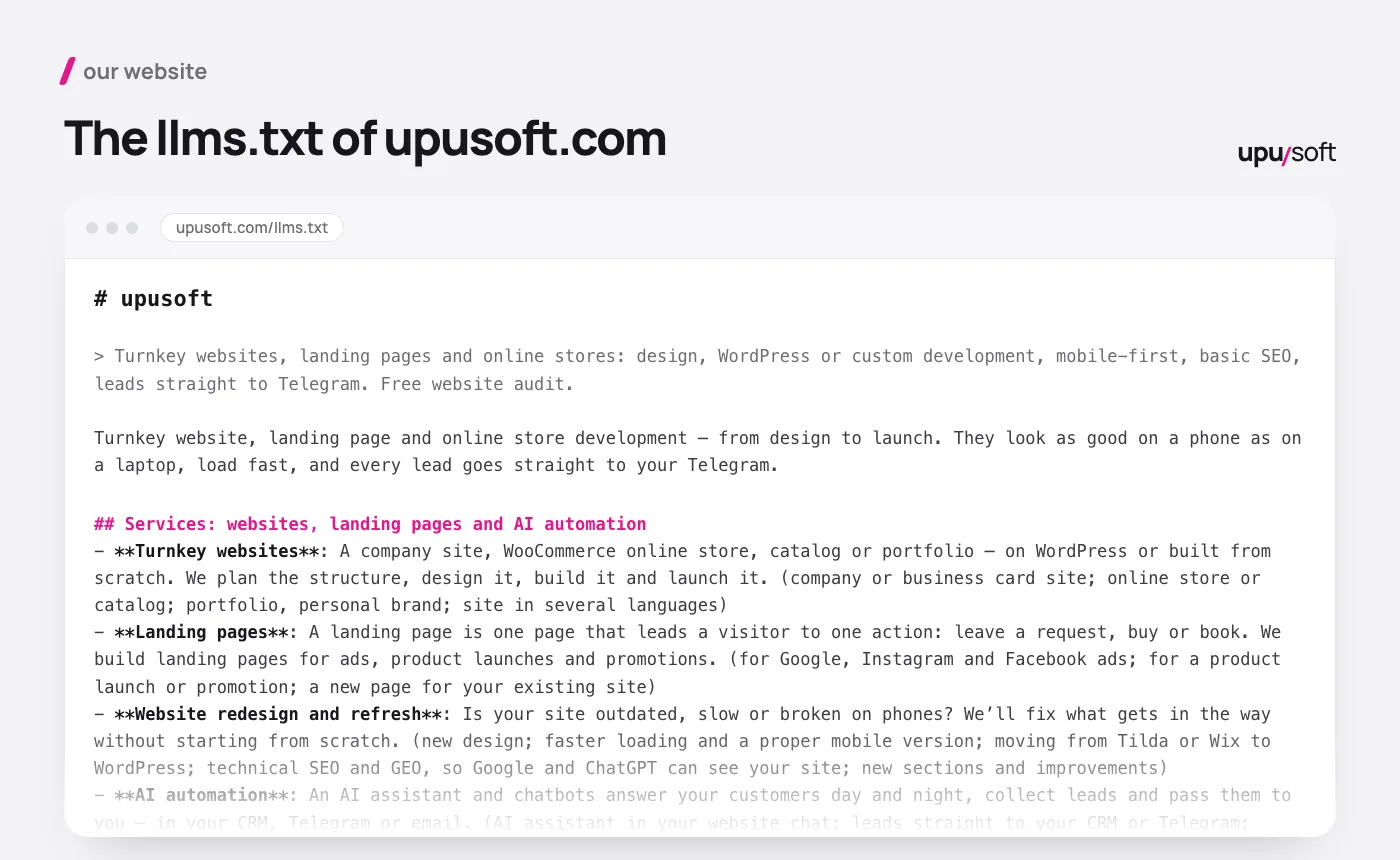
Our position: llms.txt isn’t required and guarantees nothing by itself, but it takes an hour and does no harm. We added one to our own site: it’s generated automatically from the site’s copy, so it never goes out of date when we change something.
We’ll check whether ChatGPT and Google can see your site — for free
Our free audit now includes an AI visibility check: whether your site lets in the search crawlers of ChatGPT, Perplexity and Google, and whether they can see your text and markup. Send us a link — within a day we’ll reply with a list of what’s worth fixing.
Copy that AI cites
Once the technical side is in order, the copy decides. AI doesn’t quote a whole page — it takes one or two passages that best answer the question. So GEO optimization of copy comes down to a simple rule: every important passage should be specific and make sense even without the rest of the page.
A direct answer up front
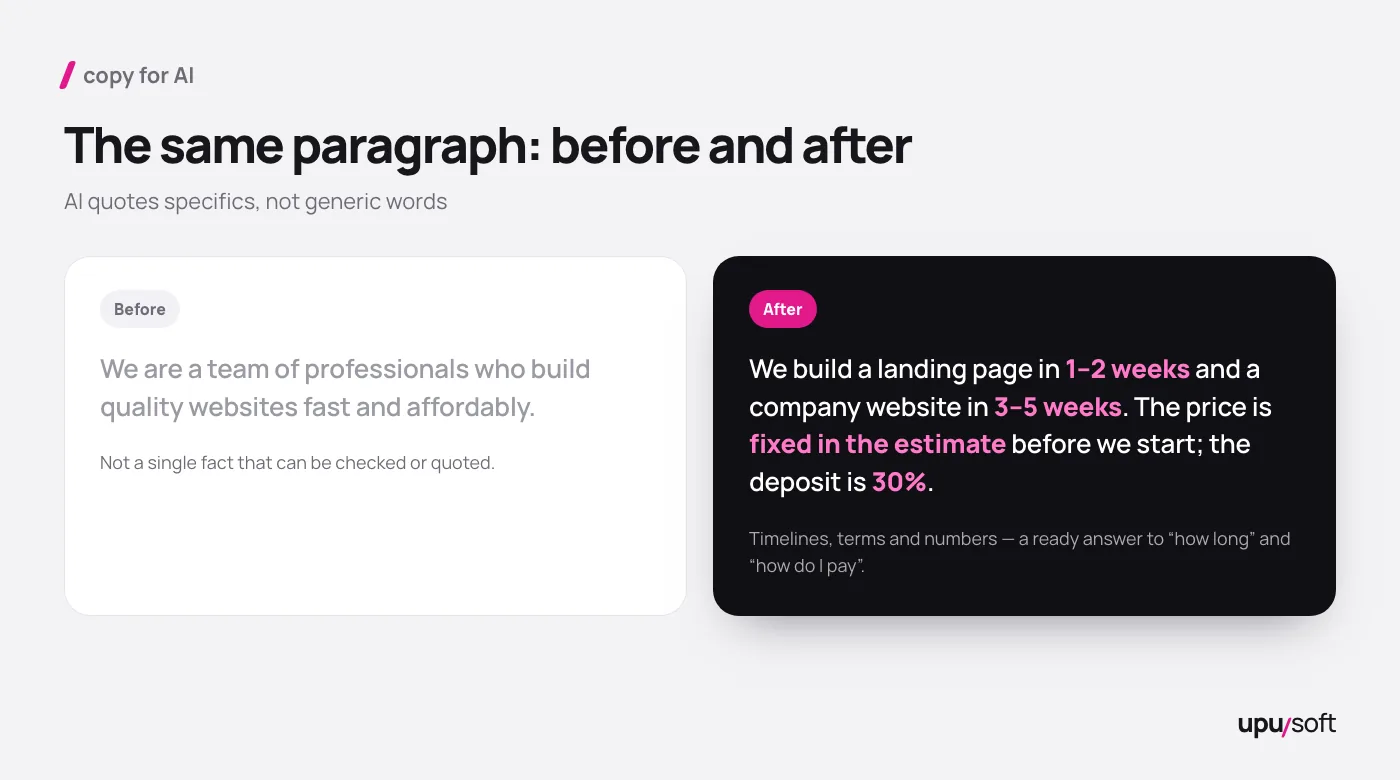
If a page answers a question, the answer should be in the first two or three sentences, not after the company history. Compare: “We are a team of professionals with years of experience” and “We build a landing page in 1–2 weeks; the price includes design, a mobile version and a form that sends leads to Telegram”. AI can take the second sentence and put it into an answer; it can’t do that with the first. It’s an old journalism rule, the “inverted pyramid”: the main point first, details after.
Question headings and self-contained paragraphs
People ask AI in full sentences: “how long does it take to build an online store”, “can I move my site off Tilda”. A heading phrased as such a question, with the answer in the first sentence below it, is the simplest way to match the query. For GEO optimization this works better than any keywords.
Write every paragraph as if it will be read on its own. Instead of “as we said, it’s cheaper” — “WordPress is cheaper than custom development because…”. AI won’t understand pronouns without a subject or references to “what we wrote above” out of context, and such a passage won’t make it into the answer.
Numbers, sources and quotes
This is exactly what the research that coined GEO tested. The authors rewrote pages in different ways and measured how visible they became in generative engine answers. Three techniques worked best: citing sources, adding quotes from experts and adding specific statistics — they raised a page’s visibility by 30–40%. Keyword stuffing, on the other hand, gave almost nothing, and on Perplexity it even made results 10% worse (Aggarwal et al., KDD 2024).
An even more interesting finding: sites that didn’t rank first in regular search gained the most. Pages ranked fifth became more than twice as visible in answers after adding citations (+115%), while top-ranked sites on average even lost a little. That’s good news for small businesses: in AI answers you can outrank bigger competitors with better copy.
In practice this means replacing generic words with facts: “fast and affordable” with timelines and a price, “lots of happy clients” with a real number, “reliable hosting” with a name and terms. Don’t make numbers up: a false fact that’s easy to disprove hurts your reputation more than having no fact at all.
| Before | After |
|---|---|
| We are a team of professionals who build quality websites fast and affordably. | We build a landing page in 1–2 weeks and a company website in 3–5 weeks. The price is fixed in the estimate before we start; the deposit is 30%. |
| Our website is convenient for customers. | Every form request goes straight to Telegram and email, so we reply within a day. |
Tables, lists, definitions
Put comparisons (“which is better”), steps and prices by type of service into tables and lists: they’re easier to parse for both machines and people, which is why they work better than solid text in GEO optimization. Write definitions explicitly, in one sentence: “A landing page is a single page that leads a person to one action.” AI assistants are constantly asked “what is…”, and a clear definition is a ready-made quote.
Dates and freshness
Ahrefs analyzed about 17 million citations in AI assistants’ answers: the pages they cite are on average 25.7% “younger” than the ones in regular Google results. ChatGPT favors fresh content the most, while Google’s AI Overviews, on the contrary, don’t give it much weight (Ahrefs).
The practical takeaway for GEO optimization: show the publication and update dates on the page, put the year in the headline for topics that change (prices, plans, rules), and update the numbers at least once a year. Simply changing the date without changing the text isn’t an option: both people and search engines notice.
Brand mentions beyond your website
AI is more willing to name those that others write about. Ahrefs compared 75,000 brands: the strongest factor linked to whether a brand appears in Google’s AI Overviews was the number of brand mentions on the web (correlation coefficient 0.664). Backlinks, which SEO has traditionally focused on, were linked much more weakly (0.218) (Ahrefs). The authors honestly note that correlation doesn’t prove causation, but the direction is clear.
So GEO optimization doesn’t end on your own website. What you can do:
- fill out your company profile on Google (Google Business Profile): contacts, opening hours, photos, replies to reviews — especially important for local businesses;
- collect reviews where people in your niche search: on Google, in industry directories, on marketplaces;
- use the same name, address and phone number everywhere — on your site, social media, directories;
- get into roundups and reviews by industry media, give expert comments to journalists;
- publish useful content on external platforms and answer in professional communities — without spam or self-promotion in every sentence.
Don’t buy fake reviews or mass “mentions”: it breaks platform rules, and exposed manipulation hurts trust more than any number of mentions helps.

How to check whether ChatGPT, Perplexity and Google can see you
GEO optimization should start with a check: it shows you what you’re working with and lets you measure results. You’ll need half an hour and a simple spreadsheet.
- Write down 10–15 questions customers ask before buying: “where can I order…”, “how much does… cost”, “which is better…”. The way they sound in conversation, with your city if you work locally.
- Ask them in ChatGPT with search, Perplexity, Gemini and Google, where you look at the AI Overview. Preferably in a new chat and logged out: answers depend on conversation history.
- Record in the spreadsheet: whether your company was mentioned, whether your site was linked, who was named instead of you, and which pages were cited.
- Repeat once a month. AI answers change, so look at the trend, not at a single answer.
Analytics will give you part of the data. ChatGPT automatically adds the utm_source=chatgpt.com tag to links to websites, so these visits show up separately in Google Analytics (OpenAI Help Center). Visits from Perplexity, Gemini or Copilot appear as referrals from their domains — perplexity.ai, gemini.google.com, copilot.microsoft.com. AI Overviews aren’t broken out separately in Search Console; they’re part of the overall report.
Finally, look at your server logs. They show whether OAI-SearchBot, PerplexityBot and Claude-SearchBot visit your site. If a bot you need hasn’t come once in a month, check robots.txt and your hosting settings first — that’s where the problem usually is.
GEO optimization checklist
A short list you can go through yourself or with your developer:
- robots.txt allows Googlebot, Bingbot, OAI-SearchBot, PerplexityBot and Claude-SearchBot.
- The server answers these bots with 200, not 403: hosting and bot protection don’t block them.
- The site is connected to Google Search Console and Bing Webmaster Tools, with a sitemap submitted.
- Key pages — services, prices, contacts, articles — are indexed.
- The main text is in the page’s HTML, not loaded by a script.
- Pages load fast and look right on a phone.
- Organization, Article and FAQPage markup is in place and matches the visible text.
- Key pages give a direct answer in their first sentences.
- Headings are phrased as customers’ questions; paragraphs make sense without context.
- The copy has specific numbers and links to sources, not generic words.
- Pages show publication and update dates, and the numbers are current.
- A Google profile, reviews and consistent contacts on external platforms; once a month you check AI answers to your customers’ questions.
llms.txt is left off the list on purpose: it won’t hurt, but without the points above it won’t change anything.
How we did GEO optimization for our own website
We launched upusoft.com in November 2026 and built it the same way we build sites for clients. Here’s what was actually done for GEO optimization — no embellishment and no made-up results:
- Opened access to bots. This is where we found the hosting problem: the control panel appended its own rules to robots.txt, and the server returned a 403 error to some AI crawlers. We enabled access in the hosting settings and checked with requests as each bot: Googlebot, Bingbot, OAI-SearchBot, GPTBot, PerplexityBot and Claude-SearchBot now get the page with a 200 status.
- Text right in the HTML. The site runs on WordPress with a custom theme, so all the text is served by the server, with nothing loaded by scripts. Lighthouse on mobile shows 99 for performance and 100 for SEO.
- Markup. The home page has Organization with a company description, Service for each service and FAQPage for the Q&A block; blog posts have BlogPosting, breadcrumbs and FAQ.
- Three languages. The Ukrainian, English and Russian versions are linked to each other (hreflang), so search engines and AI show people the page in their language.
- llms.txt. A file describing the company, services and main pages, generated automatically from the site’s copy.
- Blog posts follow the rules from this article: a direct answer up front, question headings, sourced numbers, an FAQ at the end. An example is “How much does a website cost in 2026”.
It’s too early to talk about citation results: the site is a few weeks old, and AI assistants need time to find it and start trusting it. We’ll check the answers monthly using the method above and update this article when there’s something to show.
All of this is part of the basic SEO of every website we build — you don’t pay separately for GEO. If you already have a website, we can set up technical SEO together with GEO optimization as a separate job.
GEO for your website — as part of basic SEO or as a separate service
If we build you a new site, GEO is already part of basic SEO. If you already have a site, we’ll set up technical SEO and GEO: crawler access, indexing, markup, llms.txt and the copy on key pages. We’ll start with a free check of what’s worth fixing.
Frequently asked questions
Will GEO replace regular SEO?
No. Google says plainly that AI Overviews rely on the same fundamentals as regular search, and ChatGPT and Perplexity also find pages through search indexes. GEO optimization builds on SEO rather than replacing it.
How long does it take before a site gets cited?
Nobody can give exact timelines for GEO optimization. OpenAI and Perplexity pick up robots.txt changes in about a day, indexing new pages takes from a few days to a few weeks, and brand mentions and trust build up over months.
Does my website need llms.txt?
Not necessarily. It’s a community proposal, not a standard, and Google says such files aren’t needed for its AI features. But llms.txt takes an hour and does no harm, so we add it to our sites.
Should I block GPTBot?
Only if you don’t want your content used to train OpenAI’s models. It doesn’t affect ChatGPT search — OAI-SearchBot handles that. We advise small businesses not to block GPTBot: that way models will know your brand better.
Can I pay to have ChatGPT recommend my company?
You can’t buy a place in an answer. In 2026 OpenAI started showing ads in ChatGPT, but according to the company, they’re labeled separately and don’t influence the answers themselves (OpenAI). So promises of a “guaranteed spot in ChatGPT” are promises of something nobody controls.
Does GEO work for non-English websites?
Yes, GEO optimization works for websites in any language. Google’s AI Overviews work in more than 40 languages, including Ukrainian, and ChatGPT and Perplexity answer in many languages and cite sites in them. When we were preparing this article, we found only a handful of Ukrainian-language materials about GEO, mostly agency blogs — in many niches it’s still easier to become a source in a smaller language than in English.
Conclusion
GEO optimization isn’t separate magic but a continuation of good SEO at a time when AI gives more and more of the answers. The order is simple: first the technical side — access for search and AI crawlers, indexing in Google and Bing, text in the HTML. Then the copy: direct answers, question headings, sourced numbers, current dates. In parallel — brand mentions beyond your website. And a monthly check against your customers’ questions.
If you want to know where your website should start, order a free audit — it now includes an AI visibility check. And if you’re planning a new website, let’s discuss your project: GEO is already part of basic SEO.