Landing page or website — it depends on what you sell and where your customers will come from. A landing page is a single page for one offer and one action, most often built for ads. A website is several pages about your company, services and prices, so that people find you on Google and trust you. One service and ads — go with a landing page; several services and customers from search — you need a website. And a business that advertises actively is usually best served by a website plus landing pages for individual campaigns.
Below we explain how a landing page differs from a website, compare them in a table, give you three questions that help you decide in five minutes, and share price and timeline benchmarks. We build both landing pages and turnkey websites, so our advice isn’t biased toward the more expensive option.
What a landing page and a website are, in plain words
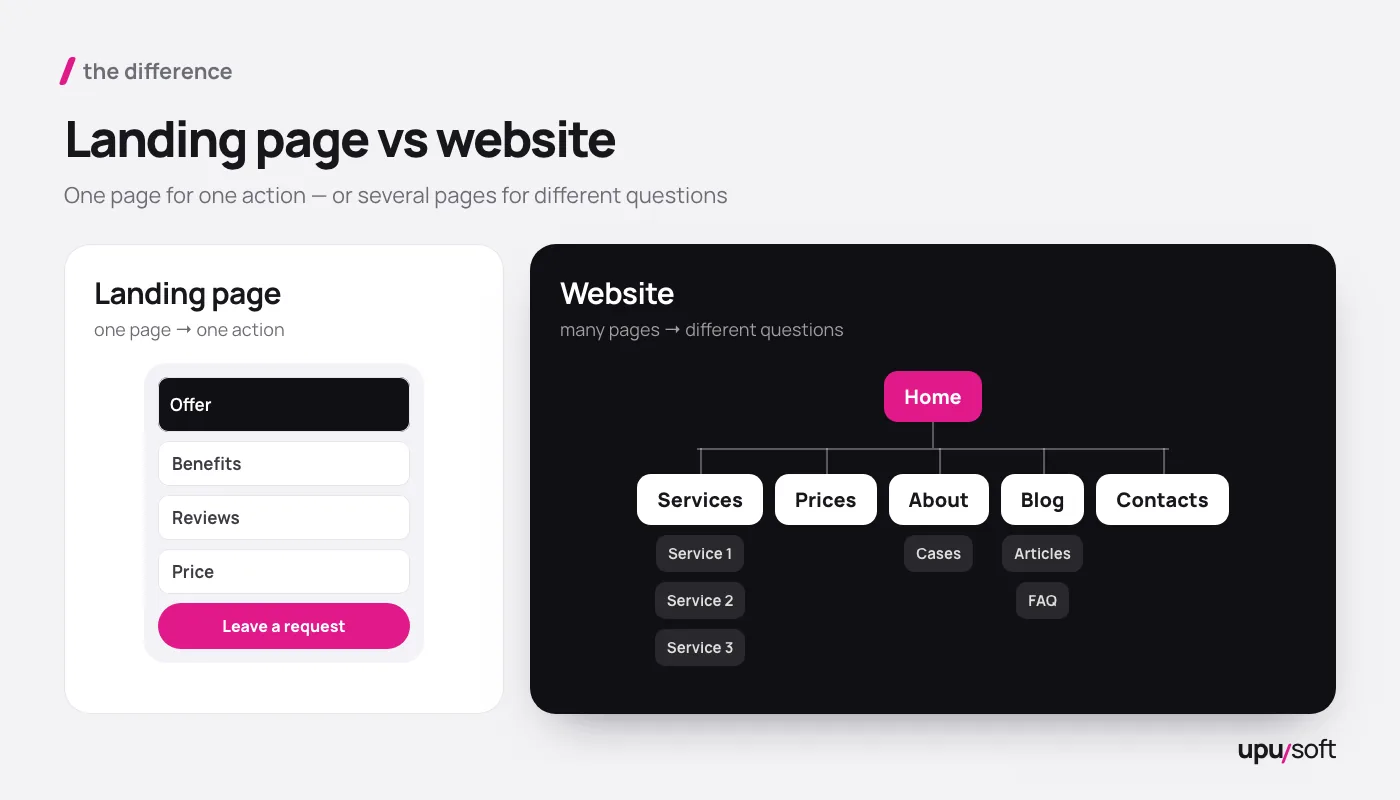
A landing page is a single page that leads a person to one action: leave a request, buy or book. It has no menu with a dozen sections: everything from the offer to the form follows one storyline from top to bottom. People usually arrive on a landing page from an ad, a newsletter or social media — already interested in something specific.
A website is several pages connected by a menu: home, services, prices, about, contacts, often a blog. It tells the story of the business as a whole and answers different questions from different people. A website is built to be found on Google and through AI assistants, to be come back to, and to be used to check you out before buying.
A business card website sits in between: a few pages, or one long page with “who we are, what we do, contacts” blocks. What sets it apart from a landing page is its purpose: a business card site introduces the company, while a landing page sells one specific thing. So the answer to “landing page or business card site” is the same — look at what the page actually needs to do.
How a landing page differs from a website: a table
The main difference isn’t the number of pages but the job. A landing page works like a salesperson having one conversation about one offer. A website is like an office people come to with different questions. All the other differences follow from that.
| Landing page | Website | |
|---|---|---|
| Job | one offer — one action | tell people about the company and all its services |
| Pages | one | from a few to dozens |
| Where customers come from | ads, newsletters, social media | Google search, AI assistants, referrals, ads |
| Google and AI search | one page — a narrow set of queries | a separate page for every service and question |
| Trust | enough for a single purchase | case studies, prices, reviews, an “about” page |
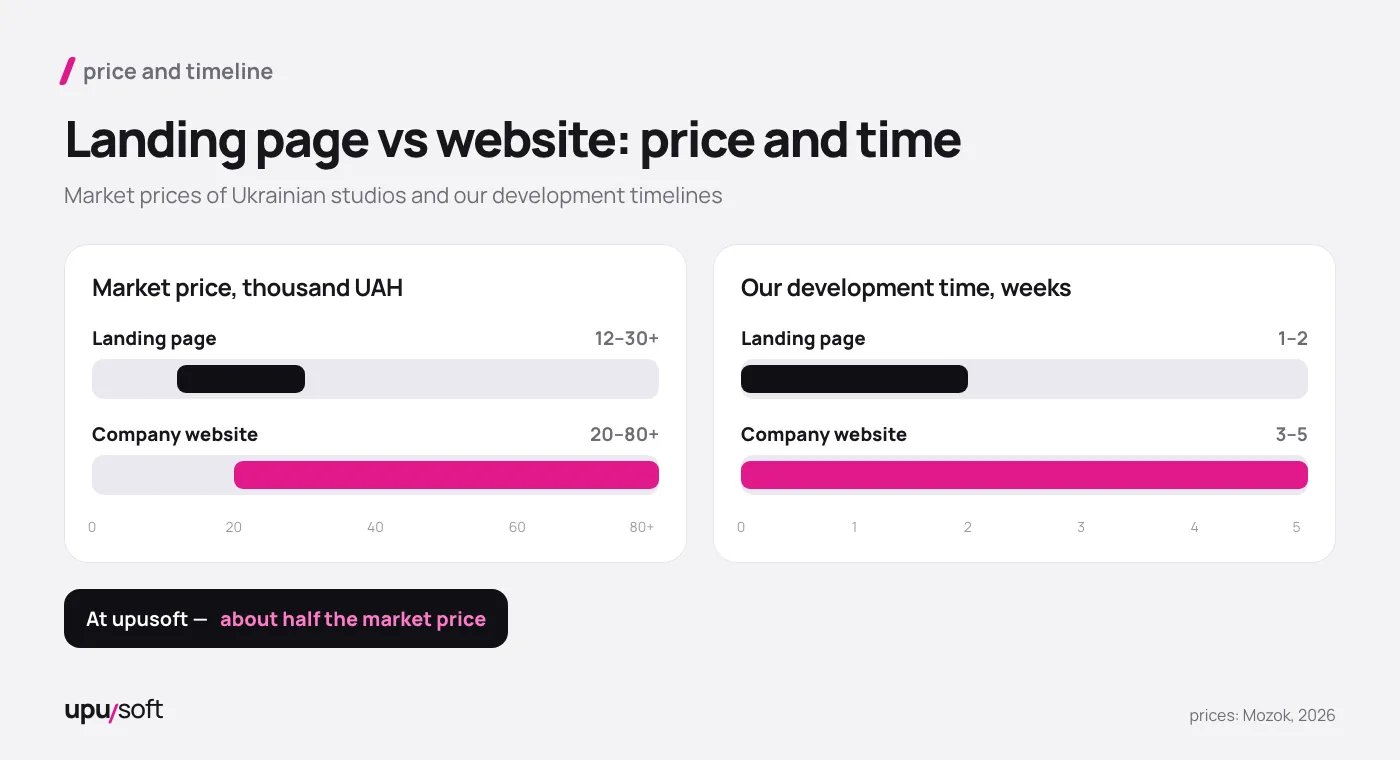
| Our development time | 1–2 weeks | 3–5 weeks |
| Market price in Ukraine | 12,000 to 30,000 UAH and up | 20,000 to 80,000 UAH and up |
| When the business grows | a new landing page for every new service | you add a page or a section |
Price source: Mozok, “How much does it cost to build a website in 2026” (in Ukrainian). Timelines are ours, from our “Timelines” section.
Note the row about Google. A landing page can be found in search, but one page can’t answer both “how much does a dental implant cost” and “treating cavities in children” equally well. A website has its own page for each such question. And it’s exactly these separate pages with direct answers that AI assistants prefer to cite — more on that in our article on GEO optimization.
When to choose a landing page
One service or product
If you sell one thing — a course, a service, a product — a landing page will present it better than a website. The whole page works toward one decision: problem, solution, benefits, price, reviews, answers to objections and a form. People don’t have to click around or look for anything. Typical examples: an online course or challenge, a workshop, a specialist’s single service, a new product.
Ads on Google, Instagram and Facebook
A landing page is made for ads. Someone clicked an ad for a specific offer — and should see exactly that offer right away, not a home page with ten sections. Google Ads separately rates landing page experience: how useful the page is, how well it matches the ad and how easy it is to use (Google Ads Help). And according to Google itself, higher-quality ads typically cost less per click and show up higher (Google Ads Help).
A launch, promotion or event with a deadline
A discount until the end of the month, enrollment for a new cohort, a conference, a seasonal offer — anything with an end date is easier to run as a separate landing page. It’s quick to launch, and after the promotion you can switch it off without touching your main website.
Testing an idea before investing in a website
Not sure there’s demand for your service? A landing page built in 1–2 weeks and a small ad budget will show whether people leave requests before you invest in a full website. If the idea works, the landing page later becomes one of the site’s pages — the work isn’t wasted.
When you need a website
Several services or lines of business
Once you have three or four services, the answer to “landing page or website” changes: a landing page starts bursting at the seams. If you describe them all on one page, it turns into a long list where people get lost, and it’s no longer clear what the “leave a request” button refers to. On a website, every service has its own page with a price, examples and a form — and people land exactly where they need to be. Dental clinics, law firms, car services, construction companies are typical cases where you can’t do without a website.
Customers search for you on Google
Ads bring people in only while you pay for them. Search is a free source that works for years, but it needs pages that answer specific queries: “dental implant price Kyiv”, “divorce lawyer”, “turnkey bathroom renovation”. A single landing page can capture maybe one or two such queries. A website with a page for every service and a blog with useful articles covers dozens. That’s why for a business that relies on search, the choice between a landing page or website almost always goes to the website.
The same goes for AI assistants: ChatGPT, Perplexity and Google’s AI Overviews use passages from specific pages in their answers. The more pages with clear answers to customers’ questions your site has, the better the chance they’ll name you.
You need trust
The more expensive the purchase, the more people check before paying: who you are, how long you’ve been in business, what you’ve done, what it costs, what clients say. A landing page gives a short answer to these questions; a website gives the full one: separate “about” pages, case studies, prices, reviews, certificates. For medicine, legal services, construction and education this is often decisive — and this is where the difference between a landing page and a website is most visible.
Online store or catalog
Here there’s really no “landing page or website” choice. A catalog with filters, a cart, payments, delivery and order management is always a website. A landing page can at most help advertise a single product or collection, but the store itself won’t fit on one page.

The third option: a website and landing pages together
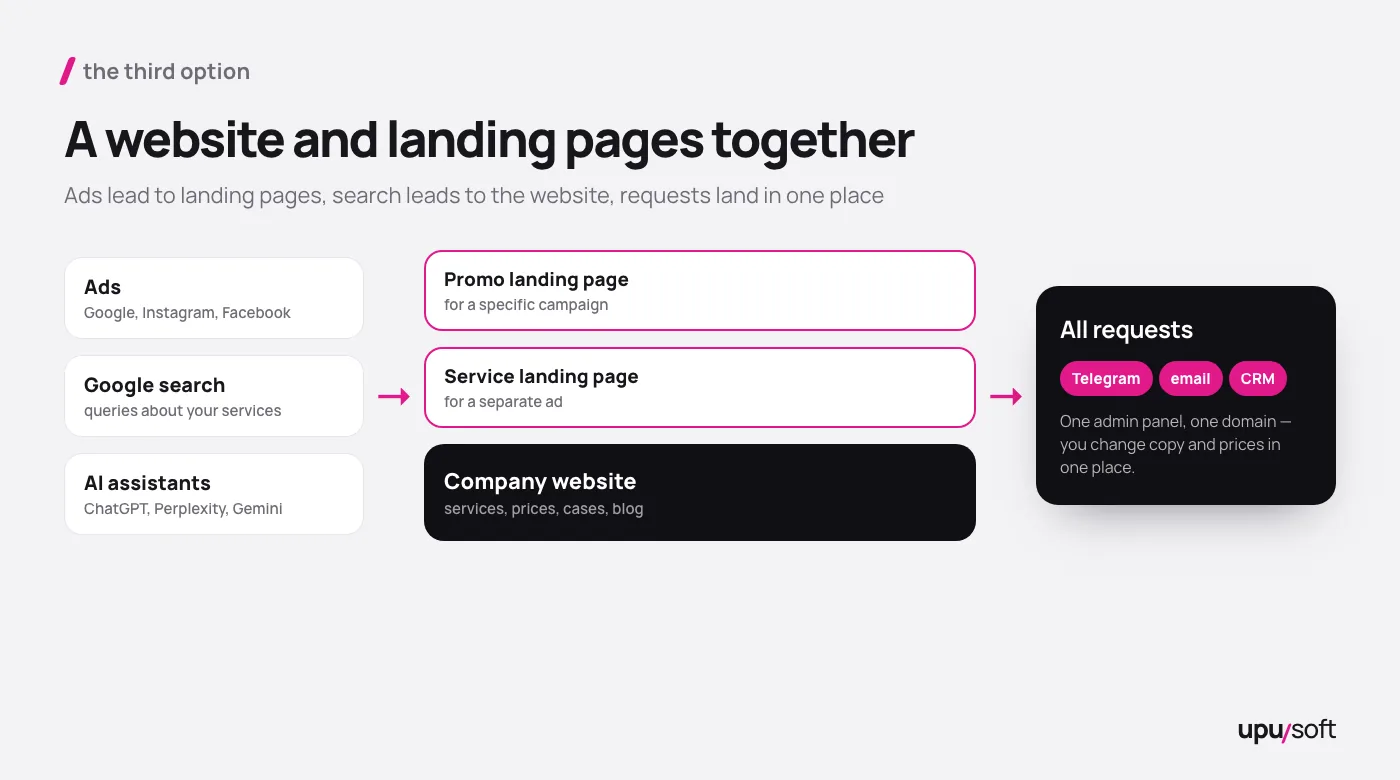
Most often, the “landing page or website” question ends with “both”. The website is the company’s “home”: people come to it from search, AI assistants and referrals, and that’s where they check whether they can trust you. Landing pages are separate pages for ad campaigns: a promotion, a new service, a seasonal offer. Every ad leads to its own page, and requests from all pages arrive in one place — for example, in Telegram and email.
Technically, landing pages can be part of the same website, on the same domain and in the same admin panel. Then you don’t pay separately for hosting and a domain for every campaign, and you change copy and prices in one place. That’s how we do it ourselves: each of our services has its own description on our website, and a separate page without the extra menu is added for ads.
If you’re starting on a limited budget, a step-by-step path works too: first a landing page for your main service and ads so that requests start coming in, and a few months later a full website, where that landing page becomes a service page.
Landing page, website or both — at upusoft it’s about half the market price
We build both landing pages and turnkey websites, and put ad landing pages on the same site so that everything lives in one admin panel. Our prices for the same work are roughly half the market rate, and we fix the scope and timeline in a written estimate. Tell us about your project — we’ll suggest a format and work out the cost for free.
What to choose: 3 questions to decide in 5 minutes
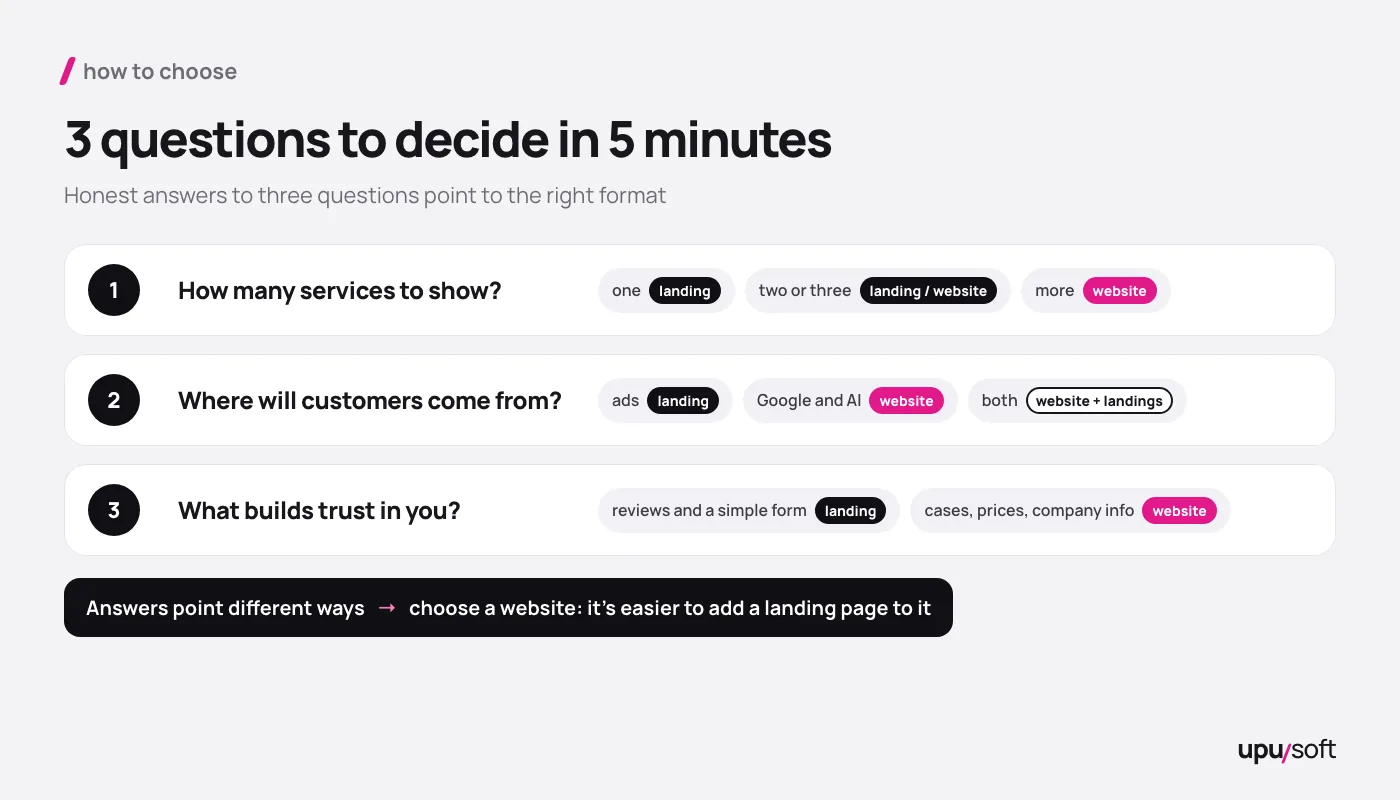
To decide between a landing page or website, you don’t need to understand the technology. Answer three questions honestly.
- How many services or products do you need to talk about? One — a landing page. Two or three related ones — a landing page or a small website. More — a website.
- Where will customers come from? Mostly from ads — a landing page. From Google search, AI assistants and referrals — a website. From both — a website plus landing pages for ads.
- What does a person need to see to trust you with their money? For an inexpensive purchase or booking a consultation, a landing page with reviews is enough. For an expensive service, a contract or a long-term relationship, you need a website with case studies, prices and information about the company.
If the answers point in different directions — say, you have one service but it’s expensive, and customers search on Google — choose a website: it’s easier to add a landing page to a website than the other way round.
Here’s how it looks in typical examples. It’s a guideline, not a rule — every business has its own circumstances.
| Business | What to choose | Why |
|---|---|---|
| Online course, challenge, workshop | landing page | one product, customers from ads and social media, a start date |
| Specialist with one service (psychologist, trainer, tutor) | landing page or business card site | one service, reviews and easy booking matter |
| Café, beauty salon | business card site | people need the address, menu or price list, opening hours and booking |
| Dental clinic, medical center | website + landing pages for promotions | many services, people search on Google, trust is needed |
| Law or construction firm | website | several lines of business, expensive services, case studies and reputation decide |
| Online store | website (store) + landing pages for product ads | catalog, cart, payments and delivery don’t fit on one page |
How much a landing page and a website cost and how long they take
According to the public price lists of Ukrainian studios compiled by Mozok, a landing page costs 12,000 to 30,000 UAH and up, and a company website 20,000 to 80,000 UAH and up. The lower end is a ready-made template; the upper end is a custom design, professional copy, and integrations with a CRM or payments. For a detailed breakdown of what makes up the price, see “How much does a website cost in 2026”.
Our timelines are: a landing page in 1–2 weeks, a company website in 3–5 weeks, an online store in 4–8 weeks. Our prices for the same work are about half the market rate. We fix the price in an estimate before we start, the deposit is 30%, two rounds of design revisions are included, and for the first month after launch we fix everything that comes up for free.
When deciding between a landing page or website, consider not only the cost of development but what happens after launch. A landing page lives on ads — that’s a permanent monthly expense. A website also needs hosting and updates, but over time it can bring in customers from search without paying for every click.
We’ll price your landing page or website within a day
Describe your project in the form — we’ll reply within a day, suggest a format and send an estimate with the page list and timeline. It will come out about half the market average.
Common mistakes
Whatever you choose, landing page or website, these are the mistakes that most often cost pages their leads:
- A landing page with a ten-item menu. People go off to “look around” other sections and never come back to the form. A landing page should have one main action.
- Ads lead to the home page. Someone clicked an ad for a specific service and landed on a page about everything at once. Every campaign needs its own page.
- One page for all services at once. It’s no longer a landing page, because there are many actions, and not yet a website, because each service lacks space. Such a page is usually worse than either option.
- Complicated copy. Unbounce, which analyzed over 41,000 landing pages, found that pages written in plain language (a 5th–7th grade reading level) converted at 11.1% — twice as often as those written in professional-level language, at 5.3% (Unbounce).
- No proper mobile version. Ads on Instagram and Facebook are mostly opened on a phone, and a page where the button is hard to tap simply burns the budget.
- Requests go nowhere. The form sends emails to spam or to an inbox nobody reads. Every request should land right where you’ll see it — in Telegram, a CRM or your work email.

Frequently asked questions
Which is better for ads — a landing page or a website?
For a specific ad campaign — a landing page, or a separate page on your website made just for that ad. The key is that after clicking, people immediately see what the ad promised them, not a home page with all your services.
Can a landing page rank on Google?
It can, but only to a limited extent: one page answers just a few closely related queries well. This is where you see how a landing page differs from a website: for search promotion across many services and questions, you need a website with separate pages and a blog.
Can a landing page later be turned into a website?
Yes, if the landing page is built on the same platform as the future website — for example, WordPress. Then it becomes a service page and the site is built around it. A landing page on a separate website builder usually has to be moved by hand.
Do I need a landing page if I already have a website?
Yes, if you’re launching ads for a specific service, promotion or product: a separate page for the ad usually brings in more requests than a general page of the website. You can make it on the same site.
How much does a landing page cost and how long does it take?
On the Ukrainian market — 12,000 to 30,000 UAH and up; with us — about half that. We build a landing page in 1–2 weeks from the moment the estimate is approved.
Is a business card website the same as a landing page?
No, although both can be a single page. A business card site introduces the company and gives contacts, while a landing page leads to one action — a request, a purchase or a booking.
Conclusion
Landing page or website is a question not about the number of pages but about the job. One offer and ads — a landing page. Several services, customers from Google and a need for trust — a website. A growing business that advertises usually needs both: a website as the foundation and landing pages for individual campaigns.
Not sure what’s right for you? Tell us about your project — on the first call we’ll suggest a format and name a price. The call is free, with no obligation.